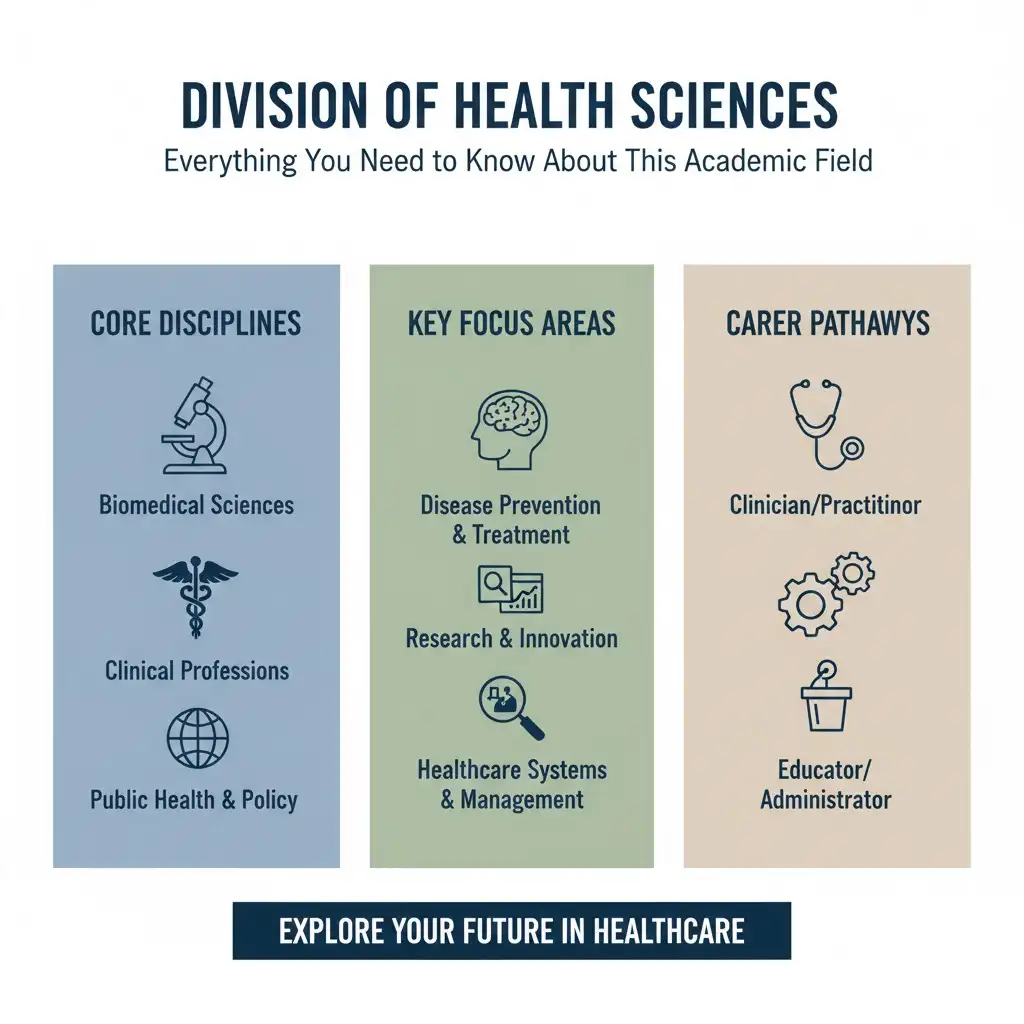
The global healthcare infrastructure is undergoing a massive transformation driven by rapid technological innovation, demographic shifts, emerging epidemiological challenges, and a paradigm shift toward precision medicine. Behind every medical breakthrough, clinical protocol, public health campaign, and life-saving diagnostic tool lies a robust, multidisciplinary academic ecosystem known as the Division of Health Sciences.
While traditional medical education focuses primarily on training physicians and surgeons, the Health Sciences division encompasses a far broader, interconnected web of scientific, clinical, analytical, and administrative disciplines. It serves as the vital bridge connecting fundamental biological research with real-world patient care, health system management, population wellness, and healthcare policy.
Whether you are a student evaluating academic pathways, a healthcare professional seeking specialization, or an academic researcher, this comprehensive guide provides an exhaustive breakdown of the Division of Health Sciences—its foundational pillars, core academic disciplines, specialized degree programs, high-growth career tracks, required competencies, and future trajectory.
Executive Overview: The Division of Health Sciences is an applied, interdisciplinary academic domain that integrates life sciences, behavioral science, quantitative analytics, and technology to optimize human health. Unlike pure theoretical biology, Health Sciences focuses directly on practical clinical delivery, health technology integration, population-level disease prevention, and healthcare system efficiency.
1. Defining the Division of Health Sciences
At its core, the Division of Health Sciences represents an umbrella organizational unit within modern universities, medical centers, and research institutes. It brings together distinct yet mutually dependent academic departments dedicated to understanding human health, diagnosing disease, delivering therapeutic care, and optimizing health systems.
A. Pure Basic Sciences vs. Applied Health Sciences
To understand the uniqueness of this field, one must distinguish between basic biological sciences and applied health sciences:
- Basic Biological Sciences (e.g., General Zoology, Plant Physiology, Molecular Biology): Primary objective is to understand biological organisms, cellular mechanisms, and evolutionary life processes purely for knowledge acquisition without immediate human application.
- Applied Health Sciences (e.g., Clinical Pathology, Physical Therapy, Health Informatics): Takes fundamental biological, chemical, and physical principles and applies them directly to solve human medical conditions, restore physical functionality, engineer diagnostic devices, and construct public health policies.
B. The Four Strategic Directives of the Field
Academic curricula and research initiatives within the Health Sciences division revolve around four primary strategic objectives:
- Etiological & Pathological Discovery: Deciphering the cellular, genetic, environmental, and behavioral drivers of acute and chronic human diseases.
- Clinical Diagnostic & Therapeutic Innovation: Developing advanced diagnostic assays, rehabilitation therapies, pharmaceuticals, and surgical protocols to improve survival and recovery rates.
- System-Wide Population Prevention: Designing community interventions, environmental health safety measures, and vaccination frameworks to stop disease before it manifests.
- Healthcare Delivery Optimization: Utilizing health informatics, data analytics, and operational management to reduce healthcare costs and eliminate healthcare disparities.
2. Core Academic Disciplines & Specialized Sub-Fields
The Division of Health Sciences is not a singular course of study; it is a matrix of interconnected sub-disciplines. These disciplines can be categorized into five distinct pillars:
The 5 Pillars of Health Sciences
1. Clinical & Allied Health Professions:
Includes Physiotherapy, Occupational Therapy, Speech-Language Pathology, Radiologic Technology, Respiratory Therapy, and Diagnostic Medical Sonography. These professionals work in direct patient care, executing rehabilitation protocols and complex diagnostic procedures.
2. Diagnostic & Laboratory Sciences:
Encompasses Medical Laboratory Science (MLS), Clinical Chemistry, Cytotechnology, Hematology, and Histotechnology. Specialists analyze tissue, blood, and genetic material to uncover cellular abnormalities and identify pathogens.
3. Population, Public Health & Epidemiology:
Focuses on Epidemiology, Biostatistics, Environmental Health, Global Health Security, and Maternal-Child Health. This branch evaluates large-scale data patterns to prevent disease outbreaks and establish health equity.
4. Nutritional & Exercise Sciences:
Focuses on Human Nutrition, Clinical Dietetics, Kinesiology, Exercise Physiology, and Metabolic Health. It investigates the metabolic impacts of diet and exercise on disease prevention and performance.
5. Digital Health, Medical Informatics & Health Administration:
Covers Health Information Management (HIM), Healthcare Data Analytics, Clinical Decision Support Systems, Telehealth Systems, and Hospital Administration. This pillar manages the operational and digital backbone of modern medicine.
3. Degree Programs & Academic Curriculum Matrix
Academic programs within the Division of Health Sciences range from undergraduate bachelor’s degrees to doctoral-level professional qualifications. Below is a structured comparative breakdown of primary degree pathways:
| Degree Track | Level & Duration | Primary Curriculum Focus | Target Professional Roles |
|---|---|---|---|
| BS in Health Sciences (BSHS) | Undergraduate (4 Years) | Anatomy, Physiology, Healthcare Systems, Ethics, Biostatistics | Pre-Med, Pre-PT, Health Coordinator, Medical Sales Specialist |
| BS in Medical Lab Science (BSMLS) | Undergraduate (4 Years) | Immunohematology, Clinical Chemistry, Pathology, Microbiology | Medical Laboratory Scientist, Diagnostic Specialist, Quality Manager |
| Master of Public Health (MPH) | Postgraduate (2 Years) | Epidemiological Modeling, Health Policy, Environmental Risk Analysis | Epidemiologist, Health Policy Director, Global Health Specialist |
| Master of Health Admin (MHA) | Postgraduate (2 Years) | Hospital Governance, Health Economics, Clinical Operations, Law | Hospital Chief Executive, Healthcare Operations Director, Executive Consultant |
| Doctor of Physical Therapy (DPT) | Clinical Doctorate (3 Years) | Advanced Biomechanics, Kinesiology, Neurological Rehabilitation, Pharmacology | Licensed Physical Therapist, Clinical Rehabilitation Director, Sports Specialist |
4. Advanced Scientific Concepts Covered in Health Sciences
Students and researchers within the Division of Health Sciences delve into highly specialized scientific concepts that bridge theoretical science and clinical application:
A. Molecular Diagnostics & Genomics
Modern diagnostic medicine has shifted from anatomical observation to genomic sequencing. Health science curricula focus heavily on Next-Generation Sequencing (NGS), Polymerase Chain Reaction (PCR) amplification, and CRISPR gene-editing frameworks. Understanding how specific genetic mutations predispose patients to oncological, cardiovascular, or metabolic diseases allows researchers to develop personalized therapeutic regimens.
B. Epidemiological Measures & Disease Transmission Dynamics
Public health and epidemiological tracks utilize quantitative mathematical modeling to calculate infection rates ($R_0$ basic reproduction number), disease prevalence, incidence density, hazard ratios, and relative risk. These mathematical models enable health scientists to forecast epidemic trajectories, evaluate herd immunity thresholds, and formulate quarantine protocols during global viral outbreaks.
C. Biomechanics & Neuromuscular Motor Control
In rehabilitation sciences, students analyze the physics of human movement. Utilizing force plates, electromyography (EMG), and motion-capture technology, health scientists evaluate joint loading forces, muscle activation patterns, and gait abnormalities. This mechanical understanding is crucial for designing custom prosthetic devices, orthopedic implants, and post-surgical rehabilitation schedules.
D. Health Data Architecture & Machine Learning (AI in Medicine)
Health Informatics trains specialists to structure massive unstructured medical datasets. This involves utilizing natural language processing (NLP) to read electronic health records (EHR), building predictive AI algorithms to detect early sepsis in ICU patients, and maintaining strict compliance with patient data privacy frameworks (such as HIPAA and GDPR).
5. High-Growth Career Opportunities and Industry Outlook
The demand for qualified professionals originating from the Division of Health Sciences is expanding rapidly. Aging global populations, chronic disease burdens, and digital health transformations guarantee exceptional long-term career stability and financial growth across multiple sectors.
🚀 Clinical Research Associate (CRA) & Manager: Oversees pharmaceutical and medical device clinical trials. Responsible for monitoring clinical protocols, ensuring trial participant safety, and submitting regulatory data to health authorities (such as the FDA or EMA).
🚀 Epidemiologist & Outbreak Investigator: Analyzes disease distribution patterns within government entities (e.g., CDC, WHO) or private research centers to control infectious diseases and address chronic lifestyle epidemics.
🚀 Healthcare Data Scientist / Informatics Director: Bridges computer science and clinical medicine. Analyzes big data to reduce medical error rates, optimize hospital staffing schedules, and deploy AI diagnostic tools.
🚀 Medical Laboratory Director: Manages advanced hospital diagnostic laboratories, validating high-complexity testing equipment and maintaining rigorous laboratory quality assurance protocols.
6. Essential Competency Framework for Health Scientists
To excel in the multidisciplinary world of Health Sciences, professionals must master a dual set of technical (hard) skills and human-centric (soft) competencies:
The Dual Competency Matrix
Technical & Analytical Capabilities:
- Statistical Literacy: Proficiency in biostatistical tools (SPSS, SAS, R, Python) to evaluate clinical trial datasets and epidemiological models.
- Laboratory Instrumentation: Hands-on operation of spectrophotometers, flow cytometers, automated immunoassay analyzers, and PCR thermal cyclers.
- Regulatory Compliance: Deep knowledge of Good Clinical Practice (GCP), Institutional Review Board (IRB) ethics, and laboratory biosafety levels (BSL-1 through BSL-4).
Human-Centric & Soft Skills:
- Interprofessional Communication: Ability to translate complex medical jargon into clear instructions for patients, community members, and non-technical stakeholders.
- Clinical Empathy & Cultural Humility: Delivering compassionate care while respecting diverse socio-cultural backgrounds and patient values.
- Ethical Reasoning: Navigating complex bioethical dilemmas regarding genetic testing, end-of-life care, and healthcare resource allocation.
7. Future Trends Shaping the Division of Health Sciences
The academic landscape of Health Sciences is constantly evolving to keep pace with global technological and environmental changes. Key trends transforming the field include:
A. Integration of Artificial Intelligence and Predictive Analytics
AI algorithms are rapidly moving from research labs into clinical practice. Health sciences curricula now integrate courses on AI ethics, machine learning model validation, and computer vision for radiology, ensuring future health workers can effectively collaborate with intelligent diagnostic systems.
B. Telehealth and Remote Patient Monitoring (RPM)
The expansion of wearable health technology, remote ECG monitors, and continuous glucose trackers has shifted healthcare delivery from traditional hospital visits to continuous home monitoring. Health science departments are leading research on sensor accuracy, remote diagnostic standards, and virtual care optimization.
C. Planetary Health and Environmental Epidemiology
There is growing recognition of the direct link between planetary health and human health. Emerging health science programs evaluate how climate change, air pollution, microplastics, and habitat destruction influence vector-borne diseases, respiratory conditions, and global food security.
Frequently Asked Questions (FAQs)
A BSN is a specialized clinical degree designed specifically to train registered nurses for direct patient care, culminating in state nursing licensure exams. A BSHS is a broader, multidisciplinary degree covering various health subjects (diagnostics, administration, public health, research), making it ideal for students aiming for non-nursing health careers, health administration, or graduate professional schools (e.g., Physical Therapy, Physician Assistant, Public Health, Medical School).
Yes, absolutely. A Bachelor of Science in Health Sciences is an excellent pre-medical pathway, provided you choose elective courses that fulfill standard medical school prerequisite requirements (organic chemistry, general biology, physics, calculus, and biochemistry) and maintain a competitive GPA.
Yes, provided the online degree program is offered by a regionally accredited university and holds relevant programmatic accreditations (such as CEPH for public health or CAHIIM for health informatics). Non-clinical tracks like Health Administration, Public Health, and Health Informatics are well-suited for online learning.
Prospective health science students should focus on building a strong foundation in Biology, Chemistry, Physics, Algebra II, Pre-Calculus, and Statistics. AP or IB courses in Biology, Chemistry, and Psychology are also highly beneficial.
8. Conclusion
The Division of Health Sciences stands as one of the most dynamic, impactful, and essential academic fields in modern society. By breaking down traditional silos between biological research, direct patient care, technological innovation, and public policy, it provides the comprehensive framework needed to solve complex global health challenges.
Whether your ambition is to analyze disease patterns as an epidemiologist, manage complex hospital networks as a health administrator, develop diagnostic tests as a medical laboratory scientist, or treat patients as a physical therapist, entering the Health Sciences division offers a rewarding career path dedicated to improving human life.
Disclaimer: This comprehensive guide is published purely for informational and educational purposes regarding university academic structures and health career choices. Program structures, degree titles, and licensure requirements vary by institution and geographical region. Prospective students should consult official university academic catalogs and regional licensing boards for specific qualification criteria.